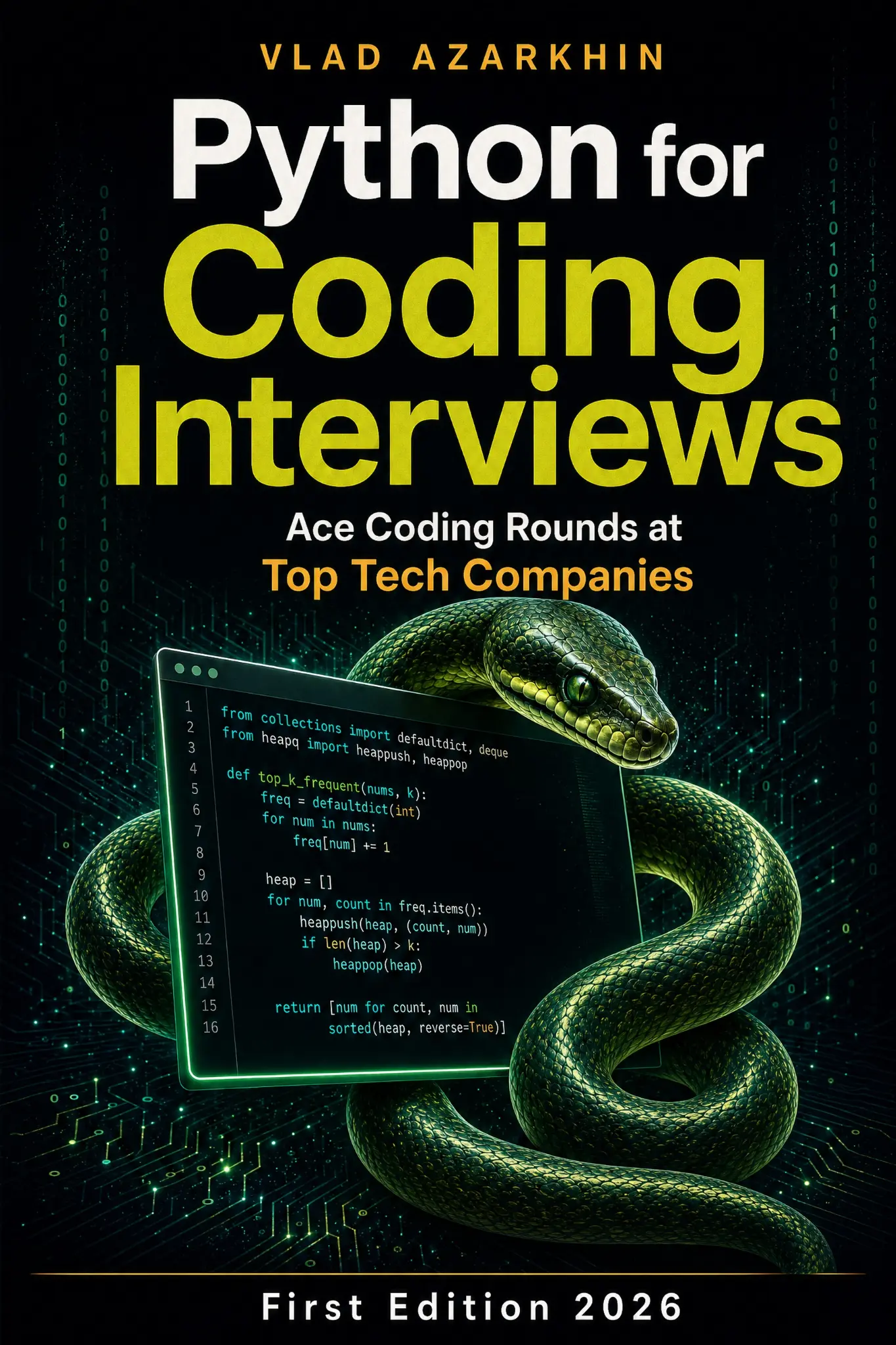
First Edition · 2026

Python for
Coding
Interviews

Ace Coding Rounds at

Google · Amazon · Meta · Apple · Microsoft

📖 12 Chapters + Bonus
📅 4-Week practice plan
📄 137 pages of interview-ready Python
Python for Coding Interviews book cover
#1
Language in technical interviews
~8
Lines for binary search vs ~12–15 in Java
12
Core Python capabilities covered
30
Curated LeetCode problems

For Engineers Who Already Know How to Code

This book is not a data structures and algorithms textbook. The sole focus is Python — the idioms, built-ins, and standard library tools that let you implement your algorithmic thinking faster, more cleanly, and with fewer mistakes during a live interview.

If you're coming from Java, C++, Go, or JavaScript, you already have the hardest part covered: you know how to think algorithmically. This book handles the rest.

🗂️
Collections & Built-ins
Counter, defaultdict, deque — the standard library tools that eliminate boilerplate and signal Python fluency.
collections module
Sorting & Pythonic Code
Custom sort keys, cmp_to_key, list comprehensions, generators, and idiomatic patterns that make Python solutions half the length of Java equivalents.
sorted() · key functions
🏔️
Heaps & Binary Search
heapq patterns, min/max heaps, bisect for O(log n) insertion, and the manual binary search template every interviewer expects.
heapq · bisect
🔧
Functools & Itertools
@functools.cache for memoization, reduce, and the itertools combinatorics toolkit for permutations and combinations.
@cache · combinations
🧩
Interview Patterns
Two pointers, sliding window, BFS/DFS, dynamic programming, and backtracking — all implemented with idiomatic Python so the language features come together.
patterns · templates
📅
4-Week Practice Plan
30 curated LeetCode problems mapped to each chapter's techniques, with a structured weekly schedule and complexity notes for every solution.
30 LeetCode problems

Python That Wins Interviews

The same problem that takes 12–15 lines in Java takes 3 in Python — when you know the right tools. This book teaches you exactly those tools.

Every chapter builds on the last, from basic idioms to full interview patterns.

interview_solution.py
# Top 3 most frequent words
# Java: ~12-15 lines. Python:
from collections import Counter

words = ["apple", "banana", "apple",
         "cherry", "banana", "apple"]

top3 = Counter(words).most_common(3)

# Memoized fibonacci — zero boilerplate
import functools

@functools.cache
def fib(n):
    if n <= 1: return n
    return fib(n-1) + fib(n-2)

# Binary search — the template
def binary_search(nums, target):
    lo, hi = 0, len(nums) - 1
    while lo <= hi:
        mid = (lo + hi) // 2
        if nums[mid] == target: return mid
        elif nums[mid] < target: lo = mid + 1
        else: hi = mid - 1
    return -1

12 Chapters, One Goal

Every chapter targets a specific category of Python knowledge that comes up in interviews — from sorting and collections to graphs and dynamic programming.

CH 00
Python Crash Course for Programmers
Optional: syntax, types, and idioms from day one
CH 01
Sorting
sorted(), key functions, cmp_to_key, stability
CH 02
Pythonic Code
Comprehensions, generators, unpacking, enumerate
CH 03
Lists & Arrays
Slicing, two pointers, in-place operations
CH 04
Strings
Immutability, join, split, sliding window patterns
CH 05
Stacks & Queues
list as stack, deque, monotonic stack patterns
CH 06
Hash Maps & Sets
Counter, defaultdict, OrderedDict, set operations
CH 07
Heaps & Binary Search
heapq, bisect, manual binary search template
CH 08
Itertools
combinations, permutations, accumulate, groupby
CH 09
Functools & Closures
@cache, @lru_cache, reduce, cmp_to_key
CH 10
Math & Bit Manipulation
Integer arithmetic, bit ops, math module patterns
CH 11
Interview Patterns
Two pointers, BFS/DFS, DP, backtracking, graphs
CH 12
Complexity & Gotchas
Big-O of every built-in, common Python traps
BONUS
Algorithms in Python
Trees, graphs, linked lists, tries, union-find
Vlad Azarkhin
Vlad Azarkhin
Principal / Staff Engineer · 25+ Years Experience

Vlad Azarkhin is a Principal/Staff-level software engineer and infrastructure architect with 25+ years of experience spanning distributed systems, infrastructure platforms, performance engineering, and AI-native applications.

He has held senior engineering and architecture roles at Microsoft, Meta, and multiple high-growth startups, and has been on both sides of the technical interview table hundreds of times — as a candidate and as an interviewer.

Read Full Bio →

Ready to Ace Your Next Interview?

137 pages of focused, interview-ready Python. No fluff, no theory you already know — just the tools that make the difference in the room.